
UX Reaserch Travel Agency
Analysis of the UX research process for a travel agency, serving as the foundation for designing optimal travel experiences.

Definition of Research Goals and Hypotheses
- Goal: To understand the needs of customers in the mid-to-upper income bracket in order to create a distinctive and profitable offering for the travel agency.
- Hypotheses: Customers are seeking unique experiences, trustworthy sources of information, and transparent services.for the agency’s offerings.
Selection of Research Methods
Choosing the right research methods is essential for understanding user needs. In this case study, the following methods were used:
- In-depth Interviews: Allowed for gathering detailed information about the motivations, preferences, and frustrations of users.
- Usability Testing: Testing the usability of the travel agency’s e-commerce website was key to ensuring that users could easily find the information they needed and make bookings without any issues.
- Card Sorting: A useful method for optimizing the information architecture of the website, so that customers could quickly find offers that interest them.

Desk Research
Description: The goal is to analyze the Polish tourism market, particularly focusing on travel agencies such as Itaka, TUI, and Rainbow, which offer a wide range of services, from budget trips to all-inclusive packages and mid-priced travel options.
Desk Research Findings:
- Popular Destinations: In the Polish market, popular travel destinations include Greece, Spain, Turkey, Egypt, and exotic locations such as the Dominican Republic, the Maldives, and Zanzibar. In these destinations, customers most often choose all-inclusive offers or packages with comprehensive on-site support.
- Key Trends: Customers primarily look for offers that guarantee peace of mind and predictability—such as all-inclusive trips with no hidden costs. Last-minute deals and family vacation packages, particularly during the holiday season, are also highly sought after.
- Competition: Major travel agencies like Itaka, TUI, and Rainbow offer a wide range of services, but they lack specialization in more unique, themed travel experiences or exceptional personalization of their offers.
Competitive Research
Competitive analysis within the tourism industry provided insights into available solutions, their strengths, and weaknesses. This analysis helped identify industry trends and key aspects to consider in user experience design.
The research was conducted based on data from four major travel agencies: Itaka, Tui, Rainbow, and Coral Travel. These agencies are among the largest and most renowned in the travel industry.
Itaka is one of the largest tour operators in Poland, specializing in organizing trips primarily to popular holiday destinations in Europe, mainly to Greece, Spain, Italy, Turkey, and islands in the Mediterranean Sea. Itaka’s offerings mainly include all-inclusive vacations, beach holidays, short weekend getaways, and sightseeing tours to major tourist attractions.
Tui is a global travel company that offers a wide range of trips to various parts of the world. In Poland, Tui specializes in beach vacations in popular European resorts such as Spain, Greece, Portugal, Italy, and exotic destinations such as the Caribbean, Southeast Asia, Africa, and South America. Additionally, Tui provides cruises, family vacations, active holidays, and package tours.
Rainbow is a tour operator specializing in diverse travel experiences. Their offerings include beach holidays in popular European and exotic resorts, as well as adventurous trips such as safaris in Africa, diving in coral reefs, and trekking in mountains. Moreover, Rainbow organizes cultural tours to destinations in Asia, Latin America, and the Middle East, allowing travelers to explore new cultures and traditions.
Coral Travel is a travel agency that focuses on providing exceptional vacations for families with children. They ensure comfortable conditions for the youngest travelers and offer a variety of family packages in different price ranges. Coral Travel’s offerings include beach vacations, family-friendly resorts, and activities tailored to family needs, making them a preferred choice for family-oriented travel experiences.
These travel agencies provide a wide range of trips tailored to different travelers’ preferences, from relaxing beach vacations to exciting adventures and explorations in exotic parts of the world. Each agency’s specialization contributes to the diversity and richness of travel options available to consumers.
Participant Recruitment
Participant Profile: Age 30–55, mid-to-upper income bracket, traveling at least twice a year, spending a minimum of 3,000-4,000 PLN per person on trips.
Methods: Recruitment is conducted through pre-screener surveys sent to individuals who have used premium travel services, as well as targeted advertisements aimed at the desired demographic on social media platforms.
In-Depth Interviews
Objective: To understand the motivations, expectations, and problems of customers who choose mid-priced travel packages (3,000–4,000 PLN per person).
Questions:
- What drives you to choose a specific travel agency?
- What are the most important factors when selecting a travel offer
- Do you take last-minute trips? Why or why not
- What issues do you encounter when planning a trip through a travel agency?
Interview Findings:
- Motivations: Respondents look for safety, price transparency, and convenience (everything organized). They value that the travel agency handles all formalities.
- Expectations: The most important factors for them are the absence of hidden fees and the ability for the agency to quickly address any problems. They also prefer clear, user-friendly booking platforms.
- Problems: The lack of personalized offers and difficulties in contacting the agency after purchase are common frustrations. Hidden costs or unavailable services upon arrival also lead to dissatisfaction.
Cognitive Biases During the Research and Their Impact on Results
During the research conducted for the travel agency „TerraTravel,” both I, as the researcher, and the participants experienced several cognitive biases that influenced the results and interpretation of the data. Below are the biases that occurred and their impact on the research:
How it occurred: As the researcher, I had pre-existing assumptions that customers traveling in the mid-price segment prioritize safety and avoiding unexpected costs. During the interviews, some respondents might have focused on these aspects because I asked about them more frequently, expecting these to be the answers I was looking for.
Impact on respondents: Some respondents might have provided answers that aligned with my assumptions, even if their personal preferences differed. They could have subconsciously overlooked other important aspects, such as the desire for more personalized trips, adventure, or unique experiences. As a result, the findings might have been limited, potentially neglecting niche market opportunities.
How it occurred: Respondents primarily recalled experiences that were the most emotionally significant or memorable to them—both positive and negative. They were less likely to remember neutral situations or those that went as expected.
Impact on respondents: Participants might have focused on extreme examples from their trips, such as particularly disastrous vacations with accommodation issues or incredibly successful trips with ideal service. This bias affects how they signal everyday service quality, which may be more representative. As a result, I might have focused too heavily on rare problems rather than addressing issues that affect a broader group of customers.
How it occurred: During the interviews, some respondents might have given answers that they thought were more socially acceptable or aligned with what they believed I wanted to hear. Instead of sharing their real negative experiences with the travel agency, they might have leaned toward more neutral or positive responses to avoid seeming overly critical or dissatisfied.
Impact on respondents: Some participants may have avoided expressing frustration with problems they encountered during their trips (e.g., long wait times for customer service responses or hidden fees), fearing they might be perceived as too demanding. As a result, the research findings could reflect a more positive reality than the respondents’ true experiences.
How it occurred: The recruited sample mainly consisted of people who regularly use all-inclusive travel packages. There was a lack of participants who prefer other forms of travel, such as self-planned trips, more personalized experiences, or thematic tours.
Impact on respondents: The dominance of all-inclusive users caused the study results to indicate a preference for this type of offer. Meanwhile, respondents might have unintentionally ignored other available options on the market or expressed preferences that were more aligned with the majority profile. This may have narrowed the scope of findings and caused me to overlook the needs of customers seeking more non-standard trips.
How it occurred: When respondents had positive experiences with one element of their trip, such as excellent customer service, they might have automatically rated other aspects of the trip as better, even if those aspects were not actually of the same quality.
Impact on respondents: Some respondents might have downplayed the importance of issues related to booking or unclear cost information because their overall positive vacation experience overshadowed those less favorable aspects. This could have led to overly positive evaluations in the study, resulting in a distorted picture of reality.
Each of these biases influenced how the respondents interpreted their experiences and how they communicated them during the interviews. To minimize the impact of these biases, future research should include more diverse sampling methods, use multiple data collection techniques (e.g., questionnaires, A/B testing), and pay closer attention to potential cognitive distortions in participants’ responses.

Persona
The persona presented in the image is Monika, a 34-year-old sociologist from Warsaw. She is married with one child and earns around 5000 PLN per month. Monika is characterized as open, social, family-oriented, active, and cheerful. She values connections with people, discovering new cultures, and finds great joy in traveling. Her main life goals include maintaining her family’s health, ensuring her child’s happiness, exploring the world, finding time for herself and her husband, and caring for her mental well-being.
Monika’s motivations include determination, personal growth, achieving goals, and a strong focus on decision-making and social engagement. Her main frustrations are COVID-19, lack of time for her passions, insufficient time for friends, and dealing with unreliable sellers.
In terms of communication channels, Monika primarily uses the internet (55%), traditional advertising (35%), and recommendations (10%). She is an active consumer of brands like Rossmann, Netflix, Empik, TUI, Itaka, and Revolut.
Her favorite brands include: Rossmann, Netflix, Empik, Itaka, TUI, and Revolut.
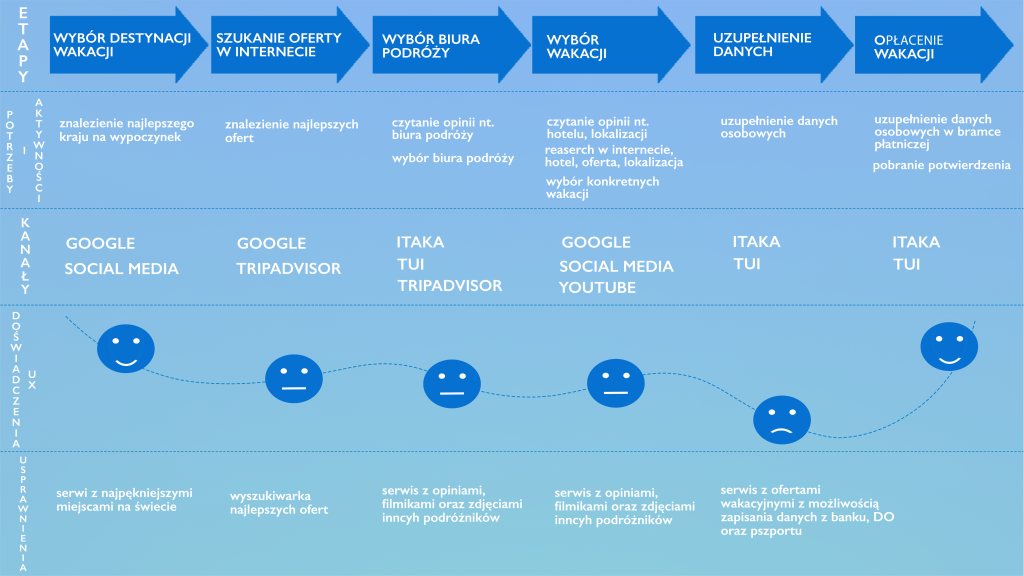
User journey map
Monika encounters several pain points during her vacation planning process, particularly in the stages of comparing offers and seeking reliable reviews. The key issues include: the complexity of comparing different vacation packages, lack of price transparency, and difficulties in evaluating diverse online reviews.
Recommended actions to improve UX:
- Optimizing comparison tools to make it easier for users to filter and compare offers.
- Increasing price transparency by clearly displaying all costs upfront and eliminating hidden fees.
- Improving the organization and filtering of user reviews to better match Monika’s specific needs (e.g., family travel).
- Personalizing the offerings based on user preferences and streamlining the checkout process through automation (e.g., pre-filled information for payments and booking).
These improvements could significantly enhance Monika’s experience as a travel agency customer, making her decision-making process smoother and reducing frustrations.
Empathy map
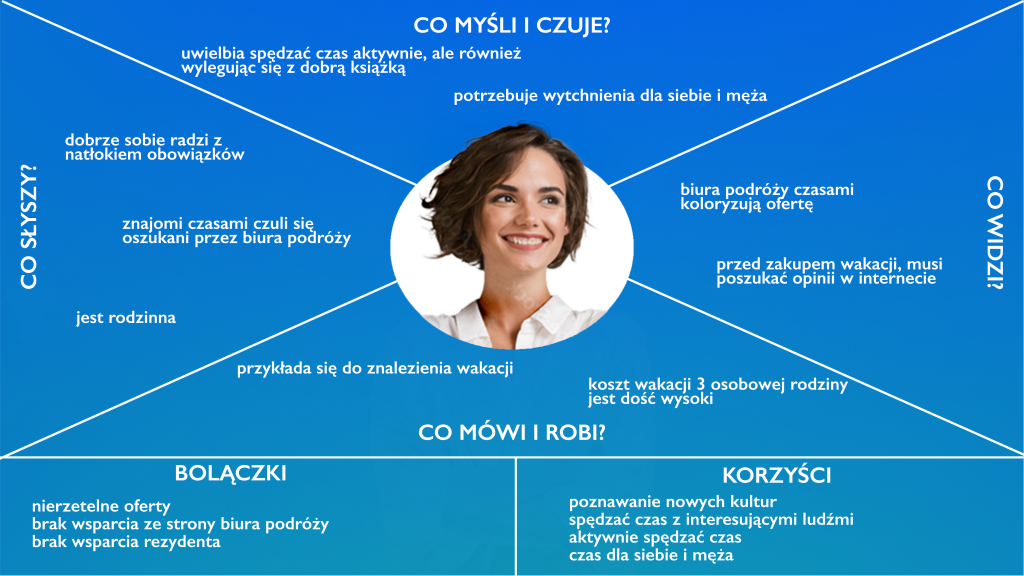
Monika’s empathy map highlights her focus on transparency and support from travel agencies. Her primary **pain points** stem from previous experiences with unreliable offers and lack of proper assistance during trips. She seeks a sense of security and trust, which she establishes by thoroughly researching reviews and offers before making decisions. Her **key benefits** include the joy of discovering new cultures and spending quality time with family. To enhance her experience, the focus should be on improving transparency in offers and providing better on-site support during her travels.
Final Analysis Summary
Participant Demographics
Number of participants:
- 10 Gender distribution:
- 7 women (70%)
- 3 men (30%)
- Average age: 35 years
Conclusion: The sample consists mainly of middle-aged women, indicating that the target demographic may lean towards families and individuals seeking stable, predictable vacations. Offers and marketing communication should consider these demographic preferences.
Travel Preferences
Types of trips:
- 6 participants prefer luxury beach vacations.
- 4 participants opt for adventure trips, such as safaris or diving.
- 7 participants prioritize family-friendly packages.
- 8 participants use online platforms to plan their vacations.
Conclusion: Most participants are looking for comfort and luxury, especially for family vacations, indicating a need for “all-inclusive” offers and dedicated family packages. Customers also expect convenience in planning and booking trips online, highlighting the importance of optimizing the e-commerce platform.
Key Frustrations (Pain Points)
- Lack of price transparency:Participants were frustrated with the lack of clear information on additional costs.
- Difficulty comparing offers: Customers struggle to easily compare vacation packages, which prolongs decision-making.
- Unreliable reviews: Inconsistent and sometimes conflicting reviews make participants feel less confident when choosing an offer.
Conclusion: The main frustrations revolve around the lack of clear, comprehensive information and difficulties in quickly comparing offers. Unreliable reviews may lead to uncertainty and hesitation, negatively impacting the user experience.
Proposed E-commerce Platform Improvements
- Increased price transparency: Implement clear cost breakdowns in offers, highlighting additional charges (e.g., for transport, excursions).
- Enhanced comparison tools: Introduce tools that allow users to quickly compare vacation packages, enabling them to easily see differences in price, services, and reviews.
- Better review organization: Introduce filters for reviews (e.g., reviews from families, couples, adventure trips) to improve credibility and ease the decision-making process.
- Offer personalization: Based on the user’s previous searches and preferences, the system could suggest the best-matching offers, saving time and improving the overall experience.
In conclusion, the comprehensive UX research has equipped the client with actionable insights to refine their brand positioning, user experience, and marketing strategies, ensuring relevance and success in the competitive e-commerce travel agency sector targeting affluent customers.